Agung Intiland, July 29, 2026
A warehouse is not just a place to store goods
When they hear the word warehouse, many people imagine a large building filled with shelves and piles of goods. In fact, in the modern industrial world, warehouses have a much broader function than just storage places.
Warehouses are an important part of the supply chain that plays a role in maintaining the smooth flow of goods, accelerating distribution, and increasing the company's operational efficiency.
Because the needs of each business are different, the type of warehouse used is not always the same. Choosing a warehouse that is suitable for operational functions can help companies reduce logistics costs, speed up the distribution process, and increase productivity.
Then, what are the types of warehouses based on their functions?
1. Storage Warehouse
Storage warehouses are the most commonly used type of warehouse. Its main function is to store goods or raw materials for a certain period of time before they are used or distributed.
This warehouse is widely used by manufacturing companies, distributors, and business actors who need a large amount of storage capacity. The storage system is usually equipped with stock management so that items remain safe and easy to find when needed.
2. Distribution Warehouse
Unlike storage warehouses, distribution warehouses are designed to speed up the movement of goods to customers or distribution branches.
Incoming items are generally only stored for a short period of time before being sent back to their next destination.
This type of warehouse is widely used by logistics companies, national distributors, and e-commerce players who need a fast delivery process. The location is generally in a strategic area with easy access to toll roads, ports, or airports.
3. Bonded Warehouse
Bonded warehouses are storage facilities that are under the supervision of the Directorate General of Customs and Excise.
These warehouses are used to store imported goods before they are marketed or further processed. Companies that use bonded warehouses can obtain various customs facilities in accordance with applicable regulations, so that the import process becomes more efficient.
This facility is widely used by manufacturing companies that use imported raw materials and export-oriented companies.
4. Warehouse Fulfillment
As digital commerce develops, fulfillment warehouses are becoming one of the most widely used types of warehouses.
In addition to storing goods, this warehouse also handles the process of receiving orders, packaging, and shipping to customers.
This model is perfect for e-commerce businesses because it is able to speed up the order fulfillment process while increasing customer satisfaction.
5. Cross Docking Warehouse
Cross docking warehouses serve as freight transit points. The products received are not stored for a long time, but are directly transferred to other vehicles for immediate distribution.
This concept helps reduce storage costs and speed up delivery times, so it is widely used in the retail, food, beverage, and logistics industries that require high-speed distribution.
6. Cold Storage Warehouse
For products that require a certain temperature, such as frozen food, pharmaceutical products, or fishery products, cold storage warehouses are used.
This warehouse is equipped with a cooling system that maintains the quality of products during the storage and distribution process. Stable temperature management is the main factor so that the product remains suitable for use when it reaches consumers.
Choosing a Warehouse Is Not the Same for All Businesses
Each type of warehouse has different functions and characteristics. Manufacturing companies certainly have the same needs as logistics companies, distributors, or e-commerce players.
Therefore, before determining the operational location, the company needs to consider several factors such as the type of business, volume of goods, distribution needs, transportation access, and potential for future business development.
Choosing the right warehouse is not only about building capacity, but also about how the facility is able to support the company's operational efficiency.
Why is a Warehouse Location as Important as a Warehouse Type?
In addition to function, location is also a factor that determines operational success.
Warehouses located in industrial areas with complete infrastructure, easy toll access, and a thriving business environment will provide added value for the company. Distribution becomes more efficient, logistics costs can be reduced, and operational activities run more smoothly.
This is the reason why many companies now choose to operate in industrial estates that already have a mature business ecosystem.
Laksana Business Park Supports Various Operational Needs
As a modern industrial and warehousing estate, Laksana Business Park is designed to support various operational needs of the company, ranging from storage, distribution, to business development.
What distinguishes Laksana Business Park is that this area has obtained an Industrial Estate Business Permit (IUKI), so that its development is carried out as an official industrial area designed to support manufacturing, logistics, warehousing, and other industrial activities in accordance with applicable regulations in Indonesia.
The existence of this industrial estate status provides added value for companies that need a business environment with clear legality, an ever-evolving infrastructure, and an ecosystem that supports long-term operations.
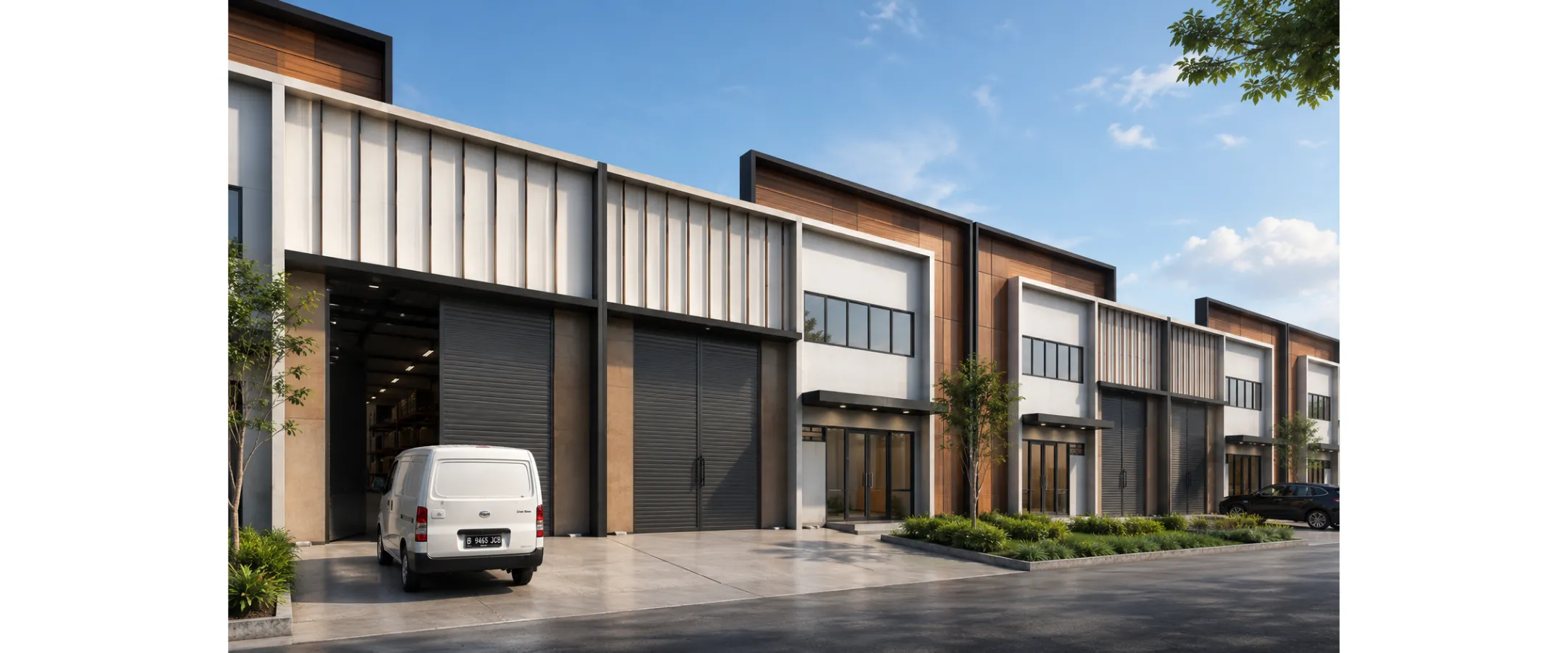
Through Luxima's products, which carry the concept of a 4-in-1 warehouse—combining warehouses, offices, business areas, and supporting rooms in one building—business actors can carry out business activities more efficiently without having to change locations.
With a strategic location in the western corridor of Jakarta, growing access, and proximity to new growth areas such as Pantai Indah Kapuk 2 (PIK 2), Laksana Business Park is one of the options for companies looking for a modern industrial estate to support business expansion and long-term investment.
Conclusion
Warehouses have a much more important role than just a place to store goods. Each type of warehouse is designed to meet different operational needs, from storage, distribution, import, to customer order fulfillment.
By understanding the function of each warehouse, companies can choose the most suitable facility to support business growth. Coupled with a strategic location and a thriving area, warehouses are not only an operational place, but also an important part of a long-term business strategy. (JP)
SEO FAQs
What are the types of warehouses based on their function?
Types of warehouses include storage warehouses, distribution warehouses, bonded warehouses, fulfillment warehouses, cross docking warehouses, and cold storage warehouses.
What is the difference between a storage warehouse and a distribution warehouse?
Storage warehouses are used to store goods for a certain period of time, while distribution warehouses focus on moving goods to get to their destination quickly.
What is bonded warehouse?
Bonded warehouses are storage facilities under the supervision of Customs that provide customs facilitation for imported and export goods in accordance with applicable regulations.
Is Laksana Business Park an official industrial park?
Yes. Laksana Business Park already has an Industrial Estate Business License (IUKI), so it is developed as an official industrial estate that supports manufacturing, warehousing, logistics, and other industrial activities in accordance with applicable regulations.